Method 01
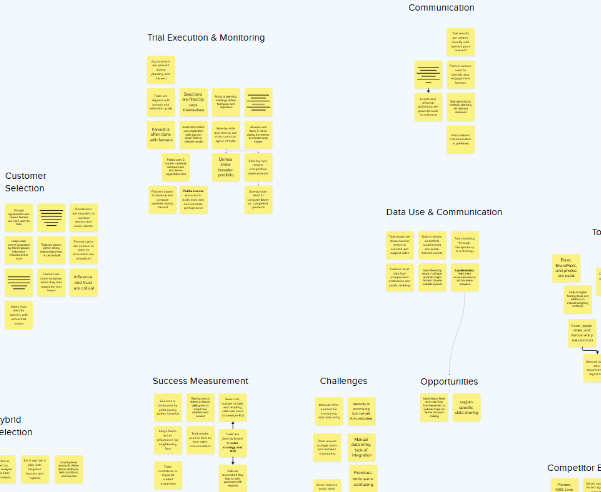
Affinity Mapping
Why
To identify recurring patterns across regions and stakeholders.
What emerged
Themes around farmer selection, planning, manual work, fragmentation and data usage.
Understanding how agricultural sales teams planned, executed and leveraged commercial trials across five regions.
Agricultural sales teams across five regions were conducting on-field product trials to test seeds and crop protection products with farmers.
The workflow behind these trials was fragmented. Each region used different processes, disconnected tools, and manual ways of tracking data.
I led cross-regional UX research to understand how the system worked in practice — and where it was breaking down.
On-field trials with farmers to test seeds and protection products.
Field observations, photos, notes and structured measurements.
Where trial data is supposed to live, be analyzed and shared.
Translating insights into regional positioning and messaging.
Recommendations, adoption strategy, and farmer-level conversations.
Years of trial activity across regions.
Insights rarely reached the people making sales calls.
Workflows, tools and roles weren't talking to each other.
A push to align field reality with strategic decisions.
Cross-regional research kicks off.
To understand how Commercial Trials actually worked across regions, I conducted interviews with stakeholders directly involved in planning, executing and monitoring trials.
The goal was to understand how teams collaborated, how data moved across systems, and how decisions were made.
I led interview moderation, synthesized findings across regions, and worked with the core team to identify operational patterns, friction points and opportunity areas.
Sales reps often selected farmers based on existing relationships, instinct and regional familiarity rather than structured data.
Influential farmers often shaped adoption across nearby farms.
The workflow appeared standardized but execution varied significantly across regions.
One process could not serve every region equally well.
Teams continued relying on Excel sheets, handwritten notes and photos despite existing tools.
Digital workflows were not fully supporting field realities.
Teams were already using trial results to influence adoption and sales decisions.
The workflow and systems were not designed around sales.
Support sales teams in selecting the right farmers and products using historical trial data and adoption patterns.
Help teams understand how trial activities influence adoption and purchasing decisions.
Simplify coordination, monitoring and reporting activities.
Enable learnings from one region to support future regions and seasons.
To identify recurring patterns across regions and stakeholders.
Themes around farmer selection, planning, manual work, fragmentation and data usage.
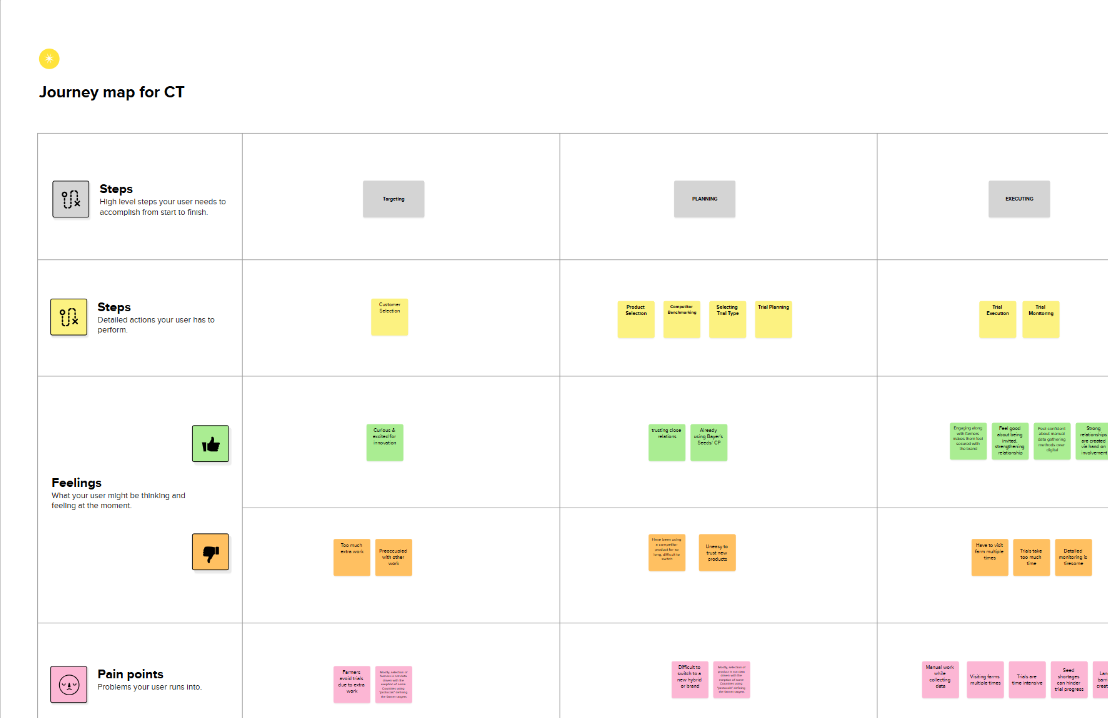
To understand workflow breakdowns.
Four major workflow stages.
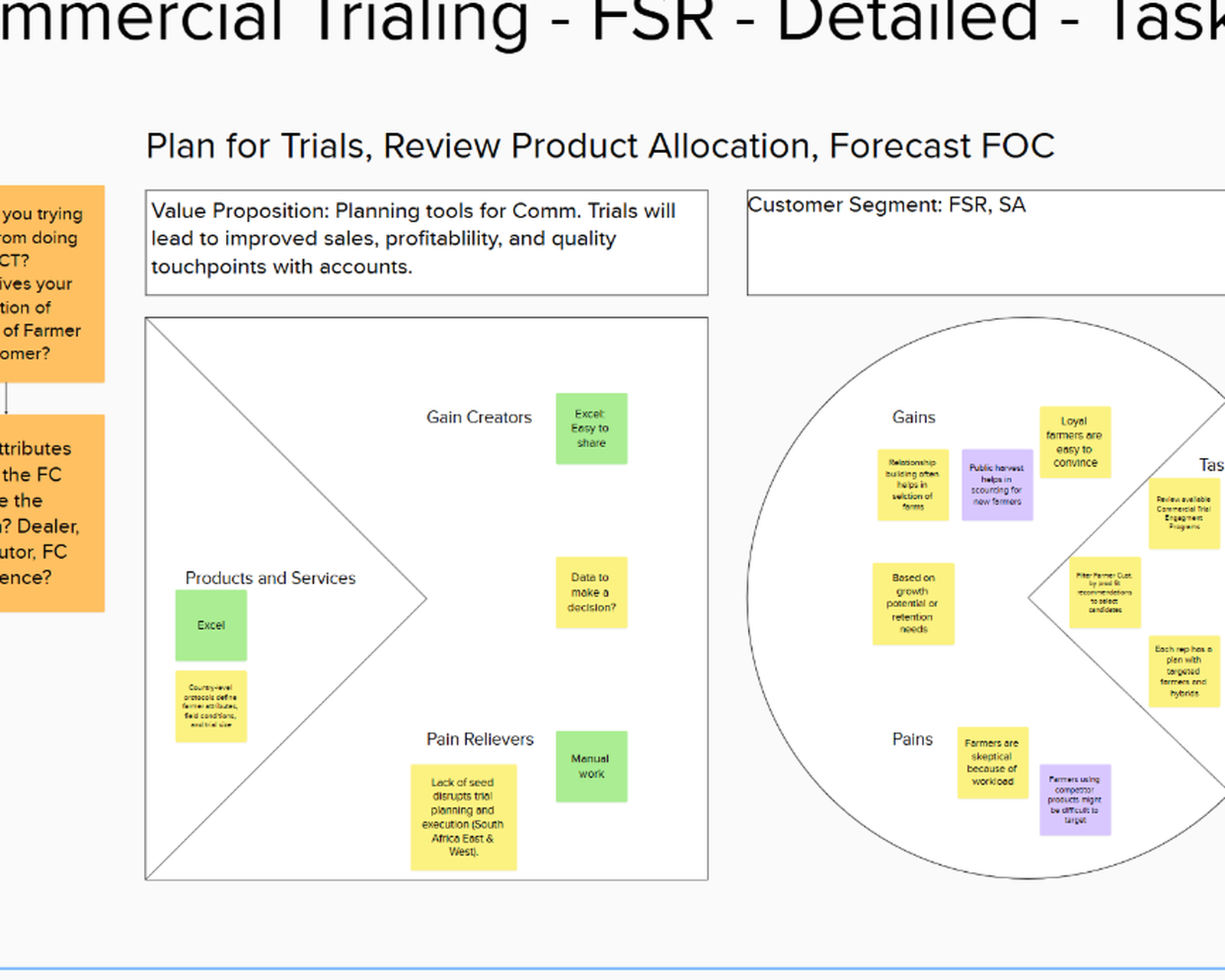
To understand sales representative goals, responsibilities and pain points.
Clearer links between trial activities and sales outcomes.
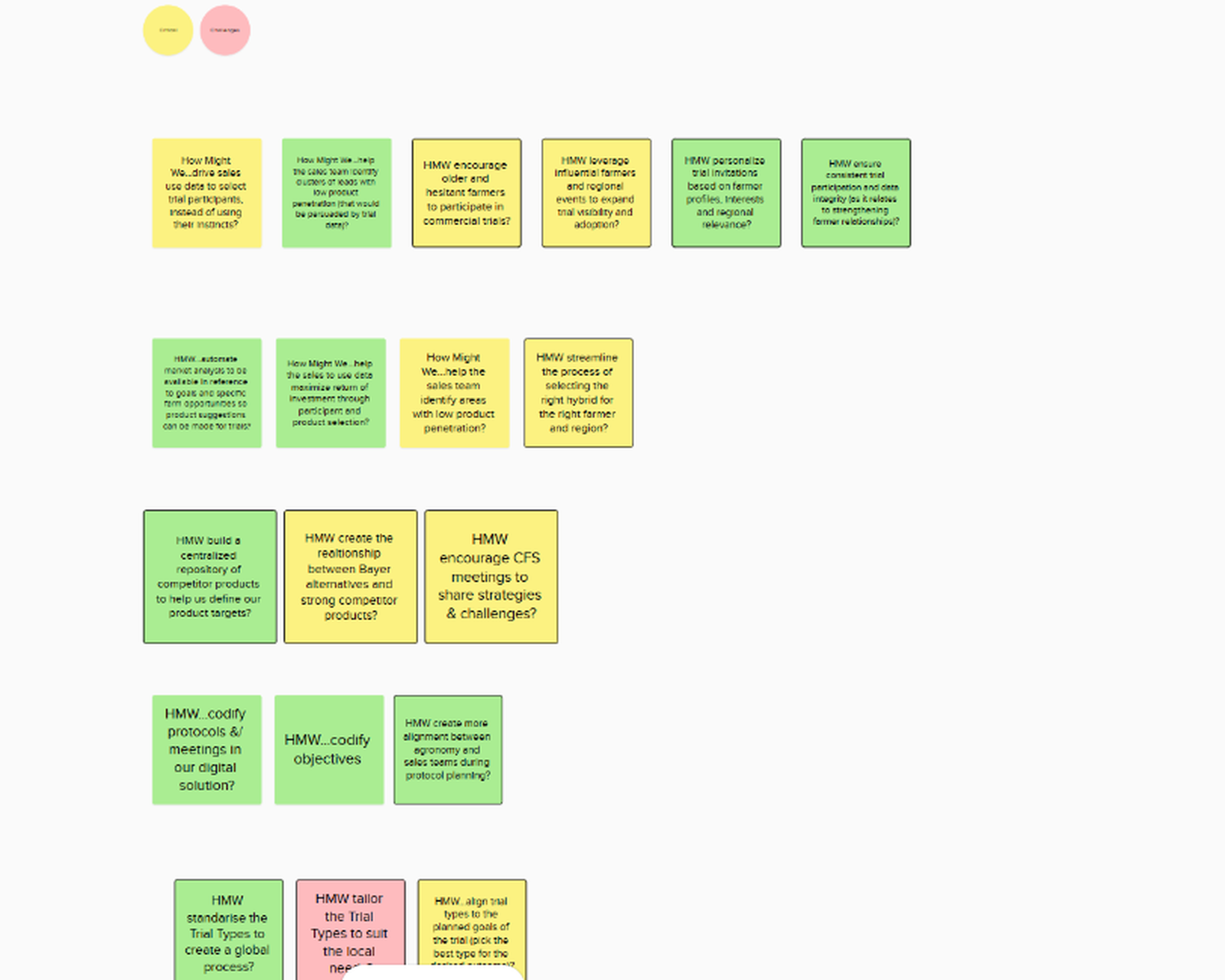
To focus on opportunities with the highest impact.
Four strategic opportunity areas.
How might we help sales teams identify the right farmers using relationship knowledge and data?
How might we streamline selecting the right hybrid for the right farmer and region?
How might we make competitor comparisons easier and actionable?
How might we create better alignment between sales and agronomy teams while preserving regional flexibility?
Shared understanding across five regions.
Clear visibility into workflow breakdowns.
Prioritized opportunities aligned across stakeholders.
Stronger connection between trials and sales outcomes.
“Commercial Trials evolved from a data collection activity into a sales enablement capability that could influence product adoption, trust and purchasing decisions.
This project taught me that workflow problems are often symptoms of larger organizational challenges. Different regions, teams, tools and priorities were all shaping how Commercial Trials operated.
What surprised me most was how heavily commercial trial success depended on relationships, trust and local farming networks.
Working across five regions reinforced the importance of balancing global consistency with local flexibility. The goal wasn't to force every region into the same process — it was to understand which parts of the workflow should be standardized, and which parts needed to remain adaptable to regional realities.